

Automatic blinds are no longer reserved for luxury homes or complicated automation projects. They have become a practical upgrade for bedrooms, living rooms, home offices, kitchens, media rooms, and oversized windows that are difficult to operate by hand.
Still, buying an automated window treatment is not as simple as choosing a fabric and adding a motor.
A quiet blackout shade may be perfect for a bedroom but unnecessary in a kitchen. A basic remote-controlled blind can work well in a guest room, while a living room with floor-to-ceiling glass may need stronger motors, grouped controls, and scheduled operation.
The best automatic blinds are the ones that match the room, the size of the window, the required level of privacy, and the way the household actually uses the space.
Quick Comparison: Best Automatic Blinds by Room
| Room or Area | Recommended Option | Most Useful Feature |
|---|---|---|
| Bedroom | Motorized blackout roller shades | Quiet scheduling |
| Living room | Motorized solar or roller shades | Grouped control |
| Home office | Programmable cellular shades | Timed glare reduction |
| Kitchen | Moisture-resistant roller shades | Remote or voice control |
| Family room | Smart motorized shades | Smart-home integration |
| Media room | Blackout shades with side channels | Maximum light blocking |
| Large windows | Heavy-duty motorized shades | High-torque motor |
| Patio doors | Motorized vertical or panel blinds | Wide-opening coverage |
This room-by-room approach prevents a common buying mistake: paying for advanced features in spaces where they provide little practical value.
What Are Automatic Blinds?
Automatic blinds are window coverings powered by a motor rather than a manual cord or chain. Depending on the system, they can be controlled through:
- A handheld remote
- A wall-mounted switch
- A smartphone application
- A smart-home platform
- A programmed schedule
- Voice commands
- Sunlight or temperature sensors
The terms automatic, motorized, smart, and programmable are often used as though they mean the same thing. They do not.
Motorized blinds use a motor to open, close, raise, lower, or tilt the window covering. Smart blinds connect with an app or home automation system. Programmable blinds can follow schedules or respond to predefined conditions.
One product may support all three functions, but motorization alone does not automatically mean the blind includes Wi-Fi, voice control, or scheduling.
1. Motorized Blackout Shades for Bedrooms
Bedrooms are usually the first place where automatic window treatments prove their value.
Closing several blinds every evening becomes repetitive. Opening them again early in the morning is not always welcome, either. A programmable system can handle both routines without requiring you to leave the bed.
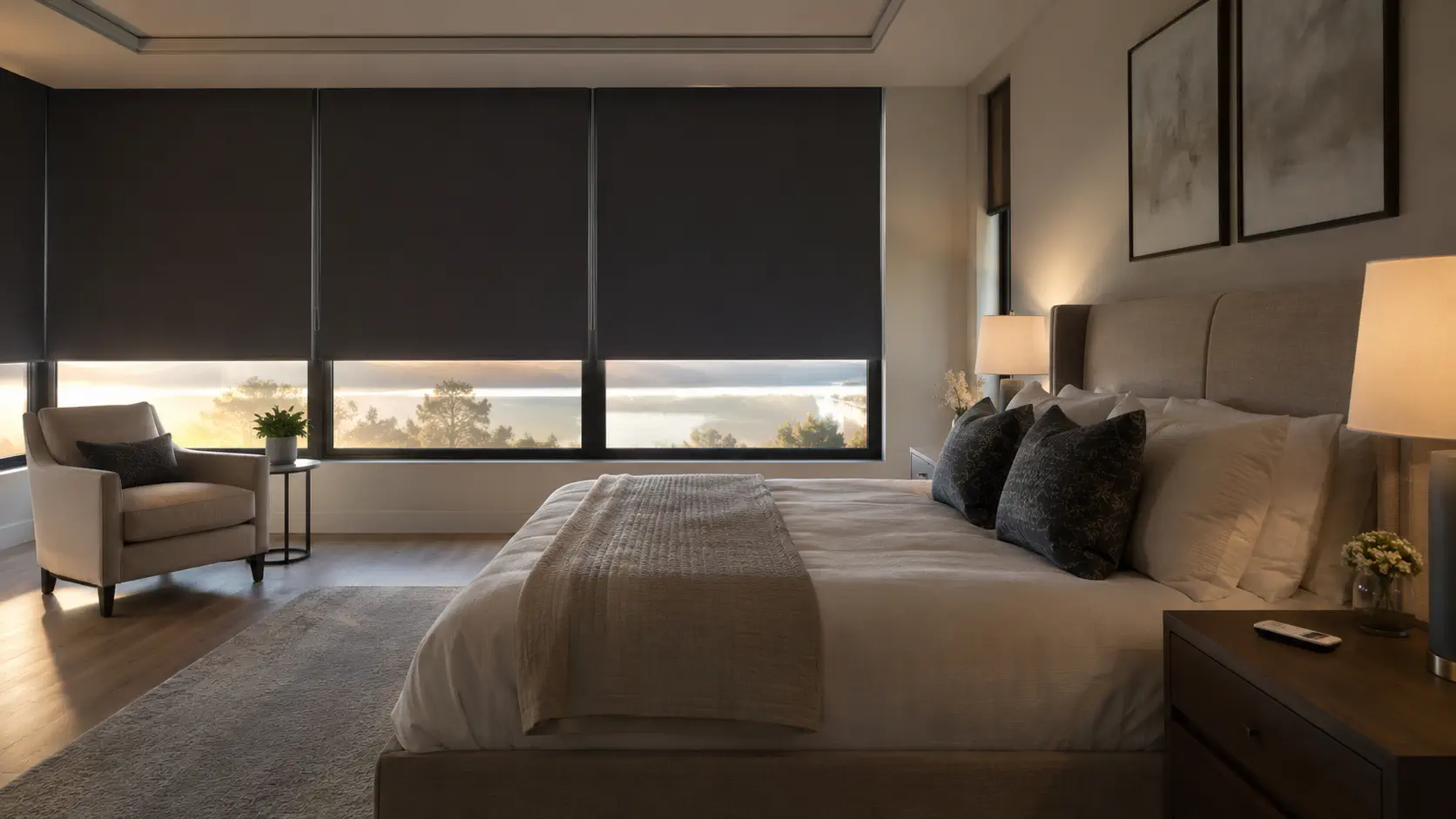
For most bedrooms, the strongest option is a motorized roller shade with blackout or room-darkening fabric. Roller shades have a clean profile, require little visual space, and can be fitted inside or outside the window frame.
Useful bedroom features include:
- Quiet motor operation
- Scheduled opening and closing
- Blackout or room-darkening fabric
- Remote control near the bed
- Adjustable morning opening times
- Battery backup or rechargeable power
- Group control for multiple windows
The mounting style matters almost as much as the fabric. An inside-mounted blackout shade may still leave thin lines of light around the edges. An outside mount provides additional overlap and can create a darker sleeping environment.
For bedrooms, motor noise should be treated as a real purchasing criterion. A motor that sounds quiet during the day may feel much louder in a silent room at 6:00 a.m.
Homeowners comparing blackout and light-filtering materials can explore the available window shades before deciding how much natural light they want to block.
2. Motorized Solar or Roller Shades for Living Rooms
Living rooms need more flexibility than bedrooms. Complete darkness is rarely the goal. Most homeowners want to reduce glare and heat while preserving daylight and the outdoor view.
This is where motorized solar shades and light-filtering roller shades perform well.
Solar fabrics can reduce harsh brightness and ultraviolet exposure without making the room feel closed. Roller shades offer a cleaner appearance and can be manufactured in a wide range of opacity levels.
The best motorized blinds for a living room should allow several preset positions rather than only fully open or fully closed.
A useful configuration may include:
- Fully open for morning daylight
- One-third closed for midday glare
- Half closed for television viewing
- Fully closed for evening privacy
Preset positions are particularly valuable when the room contains several windows. Instead of adjusting every shade separately, the entire group can move to the preferred level with one command.
For a closer look at remote, app-based, and custom automation options, direct readers to Blinds Crafter’s motorized blinds page.
Planning to automate several living room windows? Start with professional measurements. Motor size, shade width, mounting depth, and fabric weight should be evaluated together—not after the shades have already been ordered.
3. Programmable Cellular Shades for Home Offices
Sunlight can turn a productive home office into an uncomfortable workspace surprisingly quickly. Morning light may reflect directly off a monitor, while afternoon sun can raise the temperature around the desk.
Closing the shade manually solves the glare problem but often removes more daylight than necessary.
The best programmable blinds for a home office should move according to the room’s actual sun exposure. An east-facing window may need coverage during the morning, while a west-facing window may require adjustment later in the day.
Programmable cellular shades are particularly suitable for this job. Their honeycomb structure creates pockets of trapped air, making them useful for both light management and insulation.
A practical office schedule could look like this:
- Open fully at the beginning of the workday.
- Lower to 40% when direct sunlight reaches the desk.
- Return to the open position after the sun moves.
- Close automatically at the end of the day.
Home-office shades should also include a physical remote or wall switch. App control is useful, but reaching for a phone every time the lighting changes can become another interruption.
Readers interested in insulation and soft light control can compare Blinds Crafter’s cellular shades.
4. Moisture-Resistant Automatic Blinds for Kitchens
Kitchen window treatments have to deal with more than sunlight. Steam, grease, food particles, humidity, and frequent cleaning all influence the right choice.
Heavy decorative fabrics may look attractive at first but can become difficult to maintain near cooking areas. A wipeable roller shade or moisture-resistant blind is generally more practical.
Automatic operation is especially helpful for windows:
- Positioned above a sink
- Located behind a countertop
- Installed near a breakfast area
- Difficult to reach without leaning
- Exposed to strong afternoon sunlight
Voice control can be useful in a kitchen because it allows the shade to move while your hands are occupied. A simple wall switch or remote may be just as effective for homeowners who do not use a smart-home system. In this setting, the best automatic blinds are not necessarily the most advanced models, but the ones that combine convenient control with moisture-resistant, easy-to-clean materials.
The motor, charging port, and electrical components should be positioned away from direct moisture and cooking steam. Even the best automatic blinds need proper installation to operate safely and reliably in a kitchen environment. Automation improves convenience, but the system must still be selected and installed according to the conditions of the room.
5. Smart Blinds for Family Rooms
Family rooms are often connected to lighting, televisions, speakers, thermostats, and other smart-home devices. That makes them a natural place for integrated window automation.
The best smart blinds are not necessarily the models with the longest feature list. They are the ones that work reliably with the technology already installed in the home.
Before buying, check compatibility with the preferred ecosystem. Depending on the selected motor, controls may involve a dedicated application, a smart hub, voice assistants, or a broader home automation platform.
A typical evening routine might:
- Lower the shades.
- Dim the lights.
- Adjust the thermostat.
- Turn on the entertainment system.
That sounds advanced, but daily operation should remain simple. Children, guests, and family members should still be able to move the blinds without remembering a specific voice command.
This is why good smart systems retain physical controls. A wall switch or remote provides immediate access when the internet is unavailable, the app is updating, or a guest simply wants to close the shade.
Blinds Crafter’s motorized shades can be used as the main commercial link within this section.
6. Automatic Blackout Shades for Media Rooms
Media rooms need more precise light control than most other spaces. A small light gap can create glare on a television or projection screen, especially during daytime viewing.
For dedicated media rooms, look beyond fabric opacity. The installation method determines how much light actually enters around the shade.
An effective setup may include:
- Blackout roller fabric
- Outside mounting
- Extra fabric overlap
- Side channels
- A covered headbox
- Precise motor stopping points
- One-touch scene control
Side channels reduce the strips of light that often appear between the edge of the shade and the window frame. They cost more than a basic roller shade, but they can make a noticeable difference in a true theater environment.
Programming also adds value. A “movie mode” command can close the shades and adjust the room lighting at the same time.
7. Automatic Blinds for Large Windows and Patio Doors
Large windows create one of the strongest arguments for motorization. They also create one of the highest risks of choosing the wrong system.
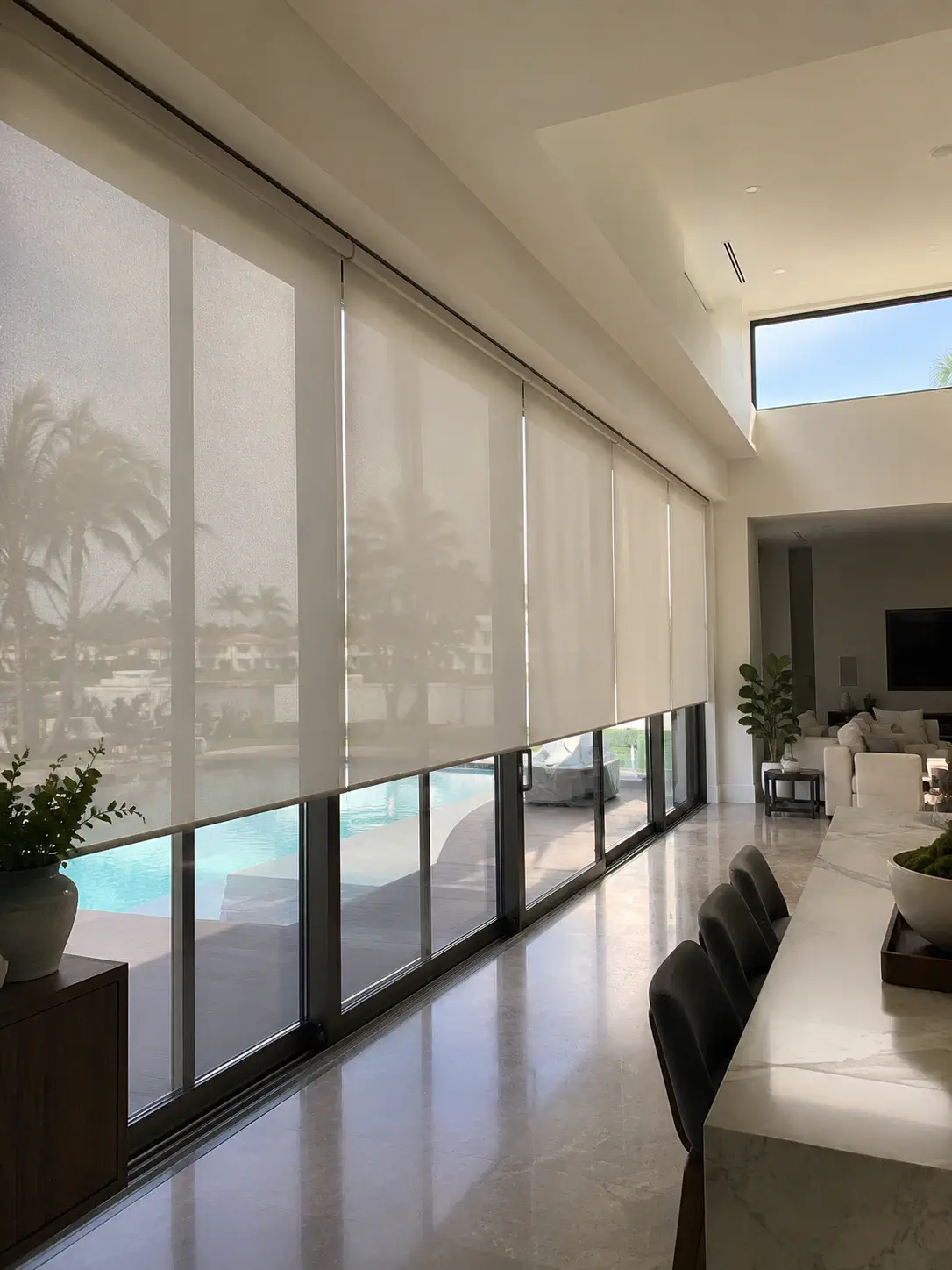
A wide shade contains more fabric, places more strain on the roller tube, and requires greater motor torque. A motor designed for a standard bedroom window may not perform reliably across a floor-to-ceiling opening.
Automatic blinds for large windows may require:
- High-torque motors
- Reinforced mounting brackets
- Wider roller tubes
- Hardwired electrical connections
- Commercial-grade components
- Multiple synchronized shades
- Custom brackets or mounting surfaces
One oversized shade may appear visually seamless, but dividing the opening into two or three synchronized sections can reduce strain and make future service easier.
Large sliding doors may also work better with motorized vertical blinds or panel-style systems. Blinds Crafter’s vertical blinds and patio door blinds pages provide useful next steps for visitors researching wide openings.
Do not order a large motorized shade using approximate measurements. Even the best automatic blinds can underperform when the window dimensions, mounting depth, or fabric width are calculated incorrectly. A small measurement error may affect alignment, fabric movement, and mounting stability. Contact Blinds Crafter for professional measurement and product guidance before choosing the motor or power source.
Remote-Controlled, Smart or Programmable: Which One Is Best?
The right control type depends on how much automation is genuinely useful.
Choose Remote-Controlled Blinds When:
- You want simple operation.
- You do not need app control.
- The property is rented.
- Guests will frequently use the room.
- Internet-based features are unnecessary.
Remote-controlled systems are often the most straightforward entry point into motorization.
Choose Smart Blinds When:
- The home already uses smart devices.
- Voice control is important.
- You want to control shades while away.
- Several devices will operate within one routine.
- App-based group control is useful.
Choose Programmable Blinds When:
- Shades should open or close at set times.
- The room receives predictable direct sunlight.
- Privacy is needed automatically every evening.
- Vacation schedules are useful.
- Energy and heat management are priorities.
In many homes, the most practical system combines all three: a remote for immediate control, an app for customization, and schedules for daily routines.
Battery-Powered vs. Hardwired Best Automatic Blinds
Power supply is one of the most important decisions in the project.
Battery-Powered Motors
Battery and rechargeable systems are easier to add to an existing home because they do not require wiring inside the wall.
They are a strong choice for:
- Standard-size windows
- Single-room projects
- Rental properties
- Retrofit installations
- Areas without nearby electrical access
The trade-off is charging. A battery-powered shade installed high above a staircase may be easy to operate but difficult to recharge.
Hardwired Motors
Hardwired systems receive continuous power and are often preferred for whole-home automation, new construction, large windows, and frequently used shades.
They are particularly useful when:
- Several shades will operate every day.
- The windows are high or difficult to access.
- The motors require greater torque.
- Electrical work can be completed before walls are finished.
- Long-term convenience matters more than lower installation cost.
Hardwiring usually requires more planning and a higher initial budget, but it eliminates routine battery charging.
For realistic budget planning, readers can continue to the motorized blinds cost guide.
What to Check Before Buying Automatic Blinds
Do not make the decision based only on fabric samples and app demonstrations. Ask questions that reveal how the system will perform after installation.
- Can the blind operate without Wi-Fi?
- Is a physical remote included?
- Can multiple shades move as one group?
- How loud is the motor?
- How often must the battery be charged?
- Is the motor rated for the shade’s weight?
- Can preset positions be saved?
- Is the system compatible with existing smart devices?
- What happens during a power outage?
- Are replacement motors and controls available?
- Does the warranty cover both fabric and motor?
- Who provides technical support after installation?
These questions are especially important when several rooms or large custom windows are involved. Choosing the best automatic blinds means looking beyond the initial price and considering motor strength, compatibility, warranty coverage, and long-term reliability. The cheapest motor is rarely the least expensive option if it needs to be replaced early.
Are Automatic Blinds Worth It?
Automatic blinds are most valuable when they solve an everyday problem.
They make sense for high windows, wide openings, rooms with several shades, homes with children or pets, spaces exposed to strong sunlight, and households that already use smart automation.
They may be unnecessary for a small, easily accessible window that is adjusted once every few days.
The decision should begin with the room—not the technology.
When the fabric, motor, controls, power supply, and installation are correctly matched, the shades become part of the home’s routine. They open in the morning, reduce glare during the day, provide privacy at night, and require very little thought.
That is the real benefit of the best automatic blinds. Not more technology. Less daily effort.
Frequently Asked Questions About Automatic Blinds
What are the best automatic blinds for bedrooms?
Motorized blackout roller shades are usually the most practical bedroom option. Look for quiet motors, scheduled controls, proper fabric overlap, and a physical remote near the bed.
What are the best programmable blinds for reducing glare?
Programmable roller, solar, and cellular shades work well for glare control. The ideal choice depends on whether you want to preserve the outside view, improve insulation, or create stronger room darkening.
Can automatic blinds work without Wi-Fi?
Many motorized blinds can still operate through a remote or wall switch without Wi-Fi. Internet access is generally required for remote app control, cloud-based schedules, or some voice integrations.
Are automatic blinds suitable for large windows?
Yes, but large shades require the correct motor torque, roller tube, mounting hardware, and power source. Some openings perform better when divided into synchronized sections.
How much do automatic blinds cost?
Pricing depends on window size, shade type, fabric, control method, power source, motor strength, and installation complexity. Standard battery-powered shades generally cost less than hardwired or oversized custom systems.
Can multiple automatic blinds open at the same time?
Yes. Compatible systems can usually group several shades so they move together. They may also allow each shade to be controlled individually when needed.
Do smart blinds improve privacy while no one is home?
Scheduled opening and closing can make a home appear occupied and ensure the windows are covered at night. They should still be used alongside standard home security measures.
Find the Right Automatic Blinds for Your Home
The right system may be a simple remote-controlled bedroom shade, a programmable office blind, or a fully integrated solution for several rooms and oversized windows.
Blinds Crafter provides custom measurement, product selection, and installation support for homeowners comparing motorized blinds, automated shades, blackout fabrics, and large-window solutions.
Ready to automate your windows with the Best Automatic Blinds? Request a free estimate and receive recommendations based on your room, window dimensions, light-control needs, and preferred control system.